Tuesday, September 24, 2019

The Most Interesting Cat in the World

Aidan with a Broken Arm
Back in 2009, when my son, Aidan, was five years old, he broke his arm on the monkey bars at school. I got the call, and was on site in no time. A quick trip to the emergency room confirmed the break with an X-ray. I was baptized as a parent when Aidan received a cast past his elbow. It was one of those nightmare days made easier by how calm Aidan was through the whole ordeal.

When I finally got home, I sent an email to my family and circle of friends. It read,

"Aidan is fine, but he broke his arm today."

It included a picture of Aidan smiling in his cast as well as the X-ray showing a clean break. He was very lucky that the bones stayed in line. It could have been worse if a bone had punctured the skin. So if there was any good to fall back on, no surgery was necessary.

Everyone responded with relief, that is, everyone except my pet friends. They were a couple who
Actual X-Ray
have eleven cats and unfortunately for them, one died the same day Aidan broke his arm. They elected not to respond to my email or show any concern for my son. Instead they sent this to a distribution list,

"We have some very sad news. One of our beloved cats, Felix, suffered sudden heart failure this afternoon just shy of his 8th birthday. He developed blood clots and unfortunately there was very little his veterinarian could do. Both of us are devastated by the loss of Felix. For those of you who knew him, you know how loving and amazingly talented he was and if ever there was a cat who tried to be human, it was Felix."

"Felix meant a lot to both us, and we sorrowfully mourn his loss."

Okay, I get it. Some people really like their pets. I could understand how they overlooked Aidan's injury in the clutches of the demise of their cat. Surely, they just didn't read my email. They closed with,

"Some of you don't know how lucky you are. Bones heal, but death is forever."

Felix the Cat
Now, that was seven years ago and the statute of limitations on stupid pet comments has finally expired. As Aidan got older, and asked why we no longer see this couple, I let him read their email. Instead of being upset, he laughed heartily to which, I, of course, joined in because I'm a crummy parent. I know people have an unrealistic perception of their pets coupled with a belief that they are part of the family, even human. It is so prevalent we have a word for it, "anthropomorphize."

A hundred years ago, advertisements showed dogs through a window in their doghouse in the backyard. People saw animals as beasts of burden, a horse pulling a cart, a cow being milked, an ox pulling a plow. Pet memorials in the papers referred to a dog that died as "man's best friend." Then in the 1930's ads showed pets curled up by the fire and memorials indicated "a loyal friend." After World War II, advertisements showed dogs sleeping on a bed and references that indicated "a member of the family." What is it about our culture that has elevated the status of animals to that of our children?

As the years passed, Aidan and I created an obituary for Felix the Cat which we recited for amusement on long car rides when only he and I were awake. It got increasingly farcical. Before we forget the life of a cat who so wanted to be a human, we decided to post our thoughts here. I welcome anyone to share their fond memories of Felix in the comments.

Felix The Cat
2001 ~ 2009

Felix was a most gifted cat. He was the youngest feline in history to circumnavigate the globe in an open rowboat. Felix served a six month tour on the International Space Station as "Special Payload." In 2004, he lost his bid for the presidency after winning a nomination from the Black Panther Party, where he ran on a platform of feline suffrage. Felix was an accomplished concert pianist. He dealt with his share of discrimination for his lack of an opposable thumb, but he didn't let that stop him. He was struck down with sudden heart failure just short of his PhD dissertation defense entitled, Feline Discrimination in Postmodern America. Felix was taken from us all too soon. He could always be counted on to find the cleanest spot on the floor whenever he had a hair ball. He will be missed by his family, friends and the world community. Felix was well known as The Most Interesting Cat in the World.

Stay frisky my friends.

Many childless pet owners have told me how I will never understand. Unlike our former friends, I've had pets, and I have children. I prefer the latter. When Dinkles the Dog plays a trumpet solo in the school jazz band, and you're beaming with pride in the audience, then maybe we can talk about family membership, but until then, I favor my own species. There's a lot of advantages of children over pets. You can talk with them, they often express their love, they rarely bite anybody, they are more than likely genetically related to you, they don't get fleas or worms, they don't chew holes in things, eventually they learn how to wipe their own butts, and they shed far less.

Bones do heal, and death is forever, but you can get a cat for under ten bucks at Petco.

Editor's Note: Originally posted on December 1, 2016.

Tuesday, September 17, 2019

Scientists Identify the Builders of Stonehenge

It’s true. Scientists recently determined through DNA analysis who the builders of Stonehenge were. If you're like me you thought it was the druids, the ancient Celtic pagans who were exempt from military service in Rome and from paying taxes, and possessed the right to excommunicate people from festivals, turning them into social outcasts. Druids were probably also lousy tippers and gave the least to charity. Apparently, druids culturally appropriated Stonehenge as their religious site and in no way had the ability to actually make something as complex and, quite frankly, as heavy.

New research published in the journal Nature, Ecology & Evolution has revealed that the ancient masons were migrants who arrived in Briton in 4000 BC. Apparently, the Neolithic people travelled from modern-day Turkey and were basically farmers who liked to build things out of stone. Eschewing the nomadic hunter-gather lifestyle, popular in Briton at the time, for a more bucolic existence meant the new inhabitants could stay in one place and build huge monuments aligned to celestial events. Farming gave these people a shitload of food allowing them to engage in leisure time activities like dragging a forty ton stone for twenty miles. You might ask the question,

How did researchers link DNA to Stonehenge?

Genetic analysis can tell you a lot of things beyond mere ancestral relationships. DNA can tell us the likelihood of contracting certain diseases as well as when and where a people migrated, even which of your siblings is more of a specific nationality than you. It can tell us why your ancestors went on the move as well as what bonded them together for thousands of years, but how can it tell us who actually built such a massive structure like Stonehenge? 

My Latest Insulation Job
I've been a home improvement guy for what seems like forever. I've plumbed piping, snaked electrical wire, shingled roofs, poured concrete, built stone walls, painted ceilings, hung I-beams, refinished floors, installed windows and doors, ran ductwork, trenched services etc. I've renovated kitchens and bathrooms. Most recently, I wired up a geothermal heater for my swimming pool. Working on 220 volt circuits always has me on my toes which is the best way to keep them on your feet.

Smashing my Finger,
circa 2014
Last week when I was insulating my pool pipes, I cut my finger pretty deeply. So deep that I dropped the knife and headed right for the house, figuring that if I didn't make it, people would think that I owed OJ Simpson money or something. I probably should've got stitches, but I didn't really have time to sit in a waiting room for two hours only to pony up a $30 copay so a nurse person in oddly mismatching clothing would glue my finger shut. Another time I pummeled my finger while on the roof. That really hurt. I almost blacked out due to the pain. Passing out on the roof usually involves a hospital stay. Not wanting to negotiate a ladder just yet, I taped my finger with a strip of Grace Tri-Flex XT Synthetic Roofing Underlayment. That stuff sticks to everything.

In 2006, I was setting some granite steps when I dropped a 400 pound stone on the pinky finger of my left hand. My guts shot out like a Play-Doh fun factory. I went to the emergency room for that one. In the triage area, they took a woman who needed a stitch in her head removed before me. I had fish bait hanging out my finger while her wound had already healed, but they made me wait anyway. Eventually, they stuffed all my innards back into my finger and sewed me back up.

So how do researchers know who built Stonehenge? They must have found DNA crushed in between the rocks. If they're lucky, they might discover an ancient finger flattened in a joint. Back then an injury might have led to an imbalance of the humors. After paying a chicken, three potatoes and a bag of grain as a copay, they would apply a mixture of fat and clay to your wound. On your way home, you'd swing by the local alchemist to pick up a healing crystal, a few leeches and a bit of mercury. To ward off evil spirits, you'd put the crystal on your forehead, drink the mercury, then have a go with the home bloodletting kit. If none of that made you feel any better, you'd call on your barber in the morning.

Some researchers believe that ancient people thought Stonehenge had healing powers due to the many nearby graves containing skeletons with broken bones. It took thousands of years to build Stonehenge. Those peeps in the ground near the monument were likely workplace mishaps. I'm no scientist, but it seems to me that Stonehenge probably caused more injuries than it healed.

Tuesday, September 10, 2019

The Middle School Infatuation with the Scientific Method

It's impossible in this country to traverse middle school without a thorough examination of the scientific method, which usually involves multiple full on projects, topped with presentations. Most of us have studied the scientific method more extensively than the Constitution, the seminal document written by the founding fathers that defines your rights as a citizen. People in this country learn the Pledge of Allegiance to the scientific method all through middle school.


Bill Nye
It's great that our preteens learn to make a hypothesis, collect data and evaluate the results. That's science. Bill Nye would stand in ovation and clap like one of Pavlov's dogs at the mere utterance of the term. It's been around since the 17th century. If it wasn't for the scientific method, we would still be going for a haircut, and a blood letting to balance the humors.

It's great that everyone has to learn about the scientific method so we don't have to argue arcane stances against creationism or intelligent design. We can simply pull out our scientific method banner and march, lock step, over anyone who doesn't agree with our well-formed, thoroughly researched, extensively tested hypotheses. The only issue I have with the middle school infatuation with the scientific method is that most of us in the course of our daily activities for better part of our entire life will never have need for the scientific method. What we more likely will need to do is some form of reengineering.

Now, reengineering is likely something you didn't study in middle school. Simply put, reengineering is figuring out how something is made, how it was assembled, how it works. You reengineer something for a very important reason, to fix it. A lot of things are going to break in your lifetime, and being able to fix things is a valuable skill. Calling in the trades every time something doesn't work is an expensive proposition. If you own a house, a car, a boat, a computer, a bicycle, anything you got to be able to fix things.

A good example is a 3-way switch which is used when you have a need to turn on a light from more than one location. I'm sure you have a 3-way circuit in your house. My son, Aidan, did in the science room in sixth grade. There were two doors in the science lab with light switches at each. The simple circuit for a switch and a light looks like this,
Simple Switched Circuit

Obviously if you have two switches at different locations you need something more in the wiring and switches to allow one switch to operate independently of the other. Understanding how this works is crucial to repairing a 3-way circuit. You can call an electrician, but it will cost you a minimum of $400, or you can fix it yourself in about twenty minutes. Your choice, Einstein.

When it came to the science fair, Aidan became very interested in the operation of a 3-way circuit. He wanted to teach his friends how to set up the circuit given wires and switches, a battery and a light. Commensurate with his generation, he developed a simulated three way circuit in Minecraft, a popular, creative building, sandbox video game.

His teacher initially rejected his proposal on the grounds that it didn't follow the scientific method. He asked if she knew how a 3-way circuit worked. She didn't. True, he wasn't purposing a possible solution to a problem plaguing mankind, but if you ever worked on one of these circuits without knowing what you’re doing, you know how difficult it is to get the wiring right. There are six connections to be made which offers you 720 possible combination with only two of them being correct.

After some negotiations, he managed to convince Madam Curie to let him proceed. He did a fantastic job explaining how a 3-way switch is actually a logical OR gate. He traced out the circuit from the power source to the light for each switch position. He even called his presentation The Or Gates Around Us.

Van da Graaf
Generator
When the judges voted on the best science project, a student whose father build a Van da Graaf generator out of some copper gutters won first prize. I sat through the kid’s explanation of how it worked, and he was under the impression that the charge came from the cord to the electric motor. Wrong answer, Tesla.

Second place was a girl with an orange and some litmus paper. As far as I could tell, she was technically correct with all her findings. It's just not very hypnotizing to hypothesize that dipping litmus paper into a glass of milk would give a neutral response, however true. Not bad, Rachel Carson.

Third place was a balloon on a string. The hypothesis was that when the clothespin was removed, the balloon would zoom along the string. Since tape was used to form a loop through which the string passed through, when the clothespin was removed, the balloon popped. Good enough for third place, Orville Wright.

Aidan got "honorable mention" because he didn't follow the scientific method. The kid who won didn't either, but when you got electric bolts shooting across the classroom and students hair standing on end, you got a winner with or without the scientific method.

I know what you're thinking. I'm a disgruntled, snowplow parent, who's annoyed that my son didn't win. That's what a friend of mine told me. He's probably right. The other day at his house, I flipped a switch, and he said,

"Don't touch that switch. If you do, the other switch over there won't work anymore."

Aidan said,

"The travelers are hooked to the wrong screws."

He was right. I took out my Swiss Army knife, and he and I wired the switch up correctly. I don't know much about snowplows, but if I had a problem with mine, my son and I would certainly figure out how to fix it.

Editor's Note: Originally posted on October 20, 2016.

Tuesday, September 3, 2019

The Genius of Good Will Hunting

Ben and Matt
In advance of the 20th anniversary, I am posting a critique of the Matt Damon, Ben Affleck breakout film, Good Will Hunting. I saw the movie in the theaters back in 1997 when Bill Clinton was president and beanie babies were all the rage. Rotten Tomatoes rates the film at 97% from critics. Now a lot of movies that one sees in their youth have a different feel when viewed later after you have gone through decades of events that life tosses your way. You grow, you mature, you embrace life on the journey to your first colonoscopy. When I was younger, I thought Good Will Hunting was terrible. I recently watched it again, and I can say, now that I am a more introspective person, a husband, a father, that the film stinks even more than ever.

Will Hunting is a super smart, lost boy who aspires to be a janitor at MIT. In the opening scenes, he's speed reading a book. Initially, I thought he was leafing through a magazine that was uninteresting to him, maybe the current issue of Janitor Monthly. Later we learn that Will can recall any page in any of the thousands of books he has lining his shelves because he's way smart. Now, I know there are people who have what is called a superior autobiographical memory which allows them to recall just about anything that ever happened to them. This concept might not have been floating around in 1997, but Will has the added ability to understand all these technical topics as well as recall everything he has previously read. He's wicked smart.

The Hollywood version of genius is always that of the consummate slacker, the guy who doesn't have to study, but can ace any test. The myth of intrinsic intelligence is revered while the more realistic notion of committed study is dismissed as commonplace. According to Malcolm Gladwell, author of Outliers, a book chronicling the factors that lead to extraordinary achievement, it takes 10,000 hours of hard work to enter the stratosphere in any field. Real genius takes a lot of tenacity, and it's this dedication that marks true brilliance.

In the film, Will explains his super smarts to his girlfriend Skylar, played by Minnie Driver, by comparing himself to Mozart. He says that Mozart could just play the piano because it made sense to him, and it's like that for him with organic chemistry. Problem is Mozart practiced his ass off at a very young age. His father was a composer and teacher. True, Mozart had a natural gift for music, but it was this gift that drove him to work hard, carrying him to extraordinary levels. His father wasn't breaking his cassinettes to practice.

Will Hunting is a natural at mathematics and organic chemistry. The issue I take with this is that no one is born with math nor organic chemistry prewired. Worse yet, Skylar, a premed student, laments about how she hates organic chem. I hope she became a dermatologist because I wouldn't want someone like her cutting into me. A few personal friends of mine are medical doctors, and they all enjoyed organic chemistry. That's why they're doctors.

Will even offers to do Skylar's homework for her like he could just jump in mid semester and bang out her college level organic chemistry problems in between buffing floors and freeing up clogged toilets. Being a janitor, he probably had plenty of free time on his hands so I'm sure he spent it perusing college level text books. Now to be fair, Matt Damon and Ben Affleck farted out this script as freshman, Damon at Harvard and Affleck at the University of Vermont. They never graduated so it's doubtful how absurd this concept was to them.

Will had been solving some tough math problems left on a whiteboard in the hallway by Professor Lambeau, the scarf and ascot wearing math teacher who occasionally tries to use his number two pencil on young female students. When Lambeau and his grad student, Tom, discover the janitor scribbling the solution to a difficult problem on the board, Lambeau confronts him. Will avoids the pair by dropping an f-bomb and scurrying away, disappearing in the bowels of the building like a phantom janitor.

Will runs into some cavone on the basketball court who tormented him in kindergarten. Talk about holding a grudge. He beats the guy so badly that when the dude comes to his cannolis are stale. I didn't grow up in Southie, but where I came from if some Irish scrapper broke an Italian's face, he would have woke up the next day spooning with a horse head. The cops show up, and Will scuffles with the boys in blue. You can tell this movie is 1997 because today if you tussle with the police, they are highly likely to put a few caps in your gut, then turn in their guns for two weeks of relaxing desk work.

Lambeau pulls some strings so Will avoids jail time if he sees a shrink. Queue the late Robin Williams as Sean, a community college psychology teacher who lost his wife to the big C. Sean and Will don't hit it off. In an early exchange they just stare at each other. This battle of wills was especially inept for the viewing audience who also just gets to stare at them staring at each other. When I saw this scene for the first time in the theatre, I didn't know it was coming otherwise I would have hit up the candy counter for more rasinettes. Eventually, Will begins to open up telling Sean that he's an "orphan," a bit of a dated word if you ask me. I kept waiting for Oliver Twist to round the corner and ask for more porridge. Will also had a dick for a foster father who gave him the choice of being beaten with a wrench, a stick or a belt. Will chose the wrench just to show him he was unafraid. Apparently, social services was not exactly monitoring the situation too closely if a foster parent was using tools on their charge.

Lambeau and Will start mathing it up together. In one scene they are impressively cancelling terms at breakneck genius speed. They slap down low in celebration as both admire the equations on the board. Lambeau weirdly puts his arm around Will, then begins rubbing his head in a way that would have made me very uncomfortable. I thought Will wanted to stay out of prison to avoid that kind of thing. Tom, Lambeau’s graduate student, apparently takes umbrage to the growing mutual affection. What tanks this scene is that the math is ninth grade polynomials which I'm sure was fresh in the minds of first year college students. If you want some impressive math at the MIT level, you have to roll out something more difficult than algebra.

The bar scene is when Will mixes it up with a student over an article they both read. The dude says,

"You’ll be serving my kids fries in a drive through on our way to a skiing trip." Will retorts, "That may be, but least I won’t be unoriginal."

This is a perfect example of what is called "stilted dialog," a common screenwriting criticism. When has anyone in any circle used "unoriginal" in a riposte? Additionally, I never understood the issue here. Damon and Affleck think reading, comprehending and quoting some obscure article on global economics is not real intelligence? Most people form their opinions from watching YouTube. Reading a white paper and absorbing the tenets is an integral part of research since you have to do a peer review when you publish a paper. The cap to this scene is when Will gets the girl’s math and says,

"Do you like apples?"

The guy says, “Yeah.”

Will retorts, "Well, I got her numba. How do you like those apples?"

If I said that around my buds back in the day, they would have collectively beat my ass just for being so lame. If I was that dude, I would have replied,

“That’s good because you’re gonna need apples, a salt lick and a feedbag."

The big breakthrough in therapy comes when Sean repeatedly tells Will,

"It’s not your fault.”

Will gives his best "Don't fock with me” then, eventually breaks down and sheds some tears because in Hollywood all psychological problems are solved with a good cry. Sean, being the great psychoanalyst at the local community college, hugs it out with Will. Afterwards, all is good. Problem solved. Who knew mental illness was so easily resolved? 

Affleck's big scene is when he somehow arranges a meeting with the employees of a tech company that Will is supposed to interview with. He extorts $200 out of these guys which they have to pay if they want to interview Will. I worked many years in the computer science field, and it's doubtful these mid-level managers, talking to Affleck, could get a company to pony up $200 to interview a janitor even if he used Lambeau as a reference.

In one scene, Lambeau asks grad student Tom to make everyone a cup of coffee. Four years of college in a tough subject like math, soldiering thru the GMAT, coming up with original research and Tom gets to make coffee for the janitor. Will at one point dismantles one of Lambeau's colleagues with a killer math proof, and Tom comforts the guy by saying that he’s a smart man and that some people just get lucky. The guy leaves as the door closes quietly behind him. Will has a smirk on his face clearly rubbing it in. Tom should have said,

"Say Will, when you finish up with that cup of joe, some frat boys blew cookies in the men's room."

Will sets fire to a proof that he casually whipped out. He drops it to the floor as he says,

"You're right, this is probably a total waste of my time."

Ironically, that's what I thought while sitting in the theatre. Lambeau pathetically jumps to the floor and puts out the fire, saving the precious math proof. In reality, the sprinkler system would have gone off causing millions of dollars of damage to the MIT math lab. Will would have got canned then spent the rest of his life a filthy homeless dude wandering the streets of Boston yelling at himself.

Harvey Weinstein, cofounder of Miramax, promoted Good Will Hunting with an aggressive "oscar campaign." The film went on to win an oscar for best original screenplay as well as best supporting actor for Robin Williams, his only oscar. Ninety-four percent of the users on Rotten Tomatoes liked the flick. Most of my friends and colleagues who did crappy in college love this film. It's as though the movie gives all the goof offs an escape from the simple fact that they partied too much and studied too little. It's not surprising that a lot of people liked this film because the way the math works out, most people are average, and as such only two percent of the population are true geniuses.

I'm sure they are in the six percent that didn't like Good Will Hunting.

Editor's Note: Originally posted on September 27, 2016.

Tuesday, August 27, 2019

Queen Size Is Not a Scrabble Word

  
When I was a kid, I was sent to the store at the top of the street for everything imaginable, milk, bread, the newspaper, batteries when we were desperate. Once my mother needed some pantyhose so off I went. When I was half way up the road my father stuck his head out the door and yelled,
 
"Queen size!"

I gave him the thumbs up. I knew the color as well. It was something easy like "brown." I readily found the item then skipped home proud of my success. When I arrived my mother was not speaking to my father. The tension was a little more palatable than the Joint Security Area in the Korean Demilitarized Zone. My father was sitting at the kitchen table in his chair with the newspaper open to the word jumble. My mother, manning the kitchen sink, was slamming dishes and cups signifying her disdain for something unbeknownst to me that went down not to her liking.

"I got the queen size," I said raising the bag aloft.

My mother threw a wet dish rag across the kitchen which landed squarely on my father's newspaper. I stood their motionless, holding the bag like one of those jockey lawn ornaments, the slightest move and Swartz was going to get his. My father carefully folded the rag then placed it on the table. He stood up then discarded his newspaper into the wastepaper basket with a thud. He stoically walked to the front door to peer out the small pie shaped windows. I put the bag on the counter and got the hell out of there since from experience I knew when a blowout of this magnitude erupted anyone of us kids usually ended up caught in the crossfire. Unfortunately I was the omega in my family so when tensions ran high the corporal usually paid me a visit.

"Now everyone knows," my mother muttered as she scrubbed a bowl.

I wasn't sure what she was talking about. The best I could come up with was she was referring to the size of her pantyhose, but I didn't get why she was mad about that. The girth of her rear end was common knowledge. I mean, it was no secret my mother had a big ass. It's not like you couldn't readily ascertain such a boldface fact just by looking at her. My mother graduated from the Harvard School of Cold Shoulder earning a PhD with honors. When it came to ignoring someone in the same room, she was master class. She didn't speak to my father or me for three days. One morning she ripped into me for not putting my clothes in the hamper. She unfurled her well rehearsed rant to satisfy her blood thirst for controversy,

"Is that your sock on the floor by the hamper?" she launched.

"I think so," I answered.

"You should be more appreciative of everything you have," she recited.

"I am."

"You kids don't appreciate anything your father and I do."

"I do," I said even thought I knew where this was going.

"You always had a roof over your head, food on the table and clothes on your back."

"It must have fell when I stuffed my clothes in the hamper," I explained.

"You left it there on purpose."

Even though arguing never led to a more agreeable outcome I did it anyway. They say when you have children you realize the sacrifices your parents made for you. I realized that you don't get credit as a parent for food, shelter and clothing. If you don't do those things, social services comes and relieves you of your children. Eventually everything went back to normal. My parents were talking to each other albeit in short incoherent grunts. In the afternoon, they resumed their epic Scrabble campaign.

My mother and father loved Scrabble. They tallied who won every game they ever played. After nearly a thousand matches, the winner was up only by one, and that changed weekly. My parents, if nothing else, were each other's Scrabble equals. They knew all the two letter Scrabble words like "xi," a Greek letter and "xu," a Vietnamese penny. Whenever my father went out playing an eight point "x" on the two letter Vietnamese penny, sometimes dropping it on a double letter, he would say,

"Thank you dong!"

"Dong" is the Vietnamese dollar. So a xu is one hundredth of a dong. They knew all the "q" words that didn't require the "u," as in "qi," "qat," "qaid," "qadi," "qintar," "qanat" and several others. Most of these words had their origins in the Middle East, and my parents hadn't a clue what any of them meant, but they used the various length words to drop the ten point "q" on a choice square. My father never said,

"Honey, when you finish your qat, the local qaid said we should check the qanat."

"Qat" is a leaf chewed in Yemen, "qaid" is a Muslim chief and a "qanat" is an ancient Persian irrigation system so it was unlikely that these words would be spoken in casual conversation in Rhode Island in 1975 or any time soon for that matter. At the time my father was one game down on my mother. Whoever was winning had bragging rights as well as feudal decree. No matter what the argument was over the reigning Scrabble champ had hand over the loser. They conceded right from wrong based on the Scrabble tally. The winner would say,

"Alright for you. We'll see who wins the next game."

Even though they had seemingly moved beyond the pantyhose incident my mother was plotting against my father over the next Scrabble match. Much later in life she admitted to making his coffee extra weak in hopes that he would fall asleep. My mother was the Scrabble bluff champion. The way bluffing in Scrabble works you can play any word you want. If another player calls your bluff, you go to the official Scrabble dictionary to look up the word. If it's not in the book, the person playing the bluff takes their letters back and loses their turn. If the word is legit, the challenger loses their turn. My parents used to put the Scrabble board on a revolving platform called a "lazy susan" so each player in turn could face the game. The board spun around all afternoon as they battled it out, my father trying to tie the score, my mother secretly trying to levy a brutal punishment for my father's town crier role in the pantyhose affair. As the game wore down and the last letters found their way onto the board, my mother went out with,

"Zick."

She smiled with delight as she began adding up the letters.

"Hold on there!" my father protested.

My mother kept on counting.

"What is 'zick'?" my father asked.

"It's a technique of decorating objects with printed media," my mother responded authoritatively.

My mother was an accomplished artist. Although she was describing decoupage, my father wouldn't have known this. He was a silversmith. He was about to challenge when I walked by. My father turned to me and said,

"You know what 'zick' is?"

Now I heard my mother's definition as I approached, and I wanted to sound like I was smart so I said,

"It's an art form using pictures from magazines or something."

My father sank back in defeat as my mother continued to tally the score. She smiled condescendingly while periodically letting out an irritating chuckle as she added up the totals. In Scrabble when you go out first, you get the points for the letters that everyone else got stuck with. My father was left with the ten point "q." When my mother finished, she announced,

"I win!"

My father slapped on his glasses then snatched the score sheet from my mother. He looked over the columns of numbers incredulously then scanned the board attempting to locate the words that matched the numbers on the sheet. Eventually he relinquished the scorecard for the Scrabble dictionary. He dove for the back of the book.

'What the hell!" my father exclaimed.

"What?" I asked.

"'Zick' is not a word!"

He looked to my mother.

"You bluffed!"

My mother had a smirk on her face that even a middle school jerk like me thought was mean. My father then turned to me and said,

"And you lied too!"

"I... I... thought that's what it was," I exclaimed defensively.
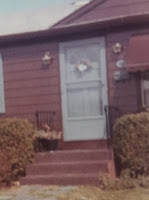
Front Door on Our House
with Semicircular
Window
My father got up from the kitchen table, turned and walked to the front door, then peered out the small pie shaped windows. He always did that when he was angry. Our house sat at the junction of a tee and faced down Jacques Street. The view out the semicircular window of the front door was that of a middle class neighborhood, filled with tightly packed houses. There was no ocean, no mountains. We were lucky to have a few trees. That's what middle class suburbia offered in the 70's. I don't know what he was thinking as he stared at length out those windows. My father never smacked us kids like my mother. She was short and couldn't look out the front door unless she stood on a stool. Growing up I thought that the view out the window was the difference between catching a beating or not, but in truth, it wasn't that simple.

My mother was two games up on my father, something that never happened in all the years of their gameplay. My father was crushed, a beaten man. He wanted a rematch, but my mother refused. She wanted time to rub Scrabble debris into my father's open wounds. It was a painful week for my father, waiting for the next game. He overheard my mother talking on the phone with one of her friends, saying,

"Oh yes, we still play Scrabble. I'm up by two games."

My father's pencil would break as he stabbed in the words of his crossword puzzle. He wasn't speaking to me either. As far as he was concerned I was a traitor. On the following weekend my mother and father reconvened for another match. My father brought his A-game. He had played many of the money letters including the "j," the "x," the "q," and the "z." He had won with an unusually large margin. My mother refused to play a second game. Still in the lead she wanted another week to gloat.

The following weekend the Scrabble game was uncommonly quiet. My mother typically talked non stop, but today she sat silently looking over her letters while occasionally surveying everything my father did. I passed by a few times only because you had to go through the kitchen to get to my room. On one pass my mother had played the "z" with the word "size." My father spun the board around and to my horror immediately predicated her word with "queen." My mother turned red as she stared at the letters my father arranged on the Scrabble board. He had played five letters with the "q" and "z" and picked up a double word to boot.

Now I knew that "queen size" was two words. I read it on the pantyhose packaging, but I wasn't saying anything. My mother was too angry to draw any logical conclusions. She just sat their and seethed. My father picked up over fifty points sealing the tying game in his favor. He was certainly going to win. He reached for the bag of letters, pulled out a few new ones, then he topped off his tray with another trip to the bag, and then he got greedy. My father in his glee forgot himself for just one critical moment. Through her anger my mother peered down at the word on the Scrabble board which slowly rotated in front of her. She looked to my father as he attempted a third trip to the bag.

My father was mildly good with slight of hand tricks. He used this skill, honed as a teenager, to cheat at poker. Now it came in handy to palm Scrabble letters then reach in the bag to drop them all while attempting to retrieve a new more higher scoring letter. The mistake he made was he had seven letters already on his tray when he had made a third trip to the bag. My mother saw it right off.

"Stop!" she ordered.

My father froze with his hand in the cookie jar. Midway through the kitchen I also stopped dead in my tracks.

"You had seven letters, and now you have five!" she summoned.

"I need two more," my father explained.

"You're swapping letters!"

"I am not!" my father said indignantly.

Then he extracted his hand from the bag. Panicing he returned a letter he was holding in his other hand back to his tray.

"You had a letter in your left hand!" my mother shouted.

"I did not," my father protested.

My father was busted. He had taught me how to cheat at checkers, Chutes and Ladders, Sorry, even chess. He honed his cheating skills when playing us kids so that the game moved along more quickly, and he could return to his newspaper and crossword puzzles. My sisters used to cheat every time they played a game with me. They were not as clever at concealing their tactics as my father, but I didn't care. I just wanted someone to play with me. My father tried to teach me to palm playing cards, but he gave up because my hands were too small. He never taught me anything of value like math or French or how to ride a bicycle. He grew up full of mischief with an absent father who was murdered in New York City in 1938. Once my father taught me how to make a time bomb with a cigarette and matches. My knucklehead friends and I blew up a mailbox on a four minute delay, time enough for us to get away. His palming skills came in handy when playing Scrabble. My mother might have been the Bluff Queen, but my father was the Palm King.

Now you might be thinking that I was devastated to embrace my father being caught cheating in Scrabble, but it was not so. Back in the 70's being a successful cheat was highly regarded in middle school. The movie, The Sting, staring Robert Redford and Paul Newman as con men won four academy award for best picture, screenplay, directory and costume design. Con men were cool, and that's what my dad was. The same year my father took me to see Paper Moon starring Ryan O'Neal opposite his real life daughter, Tatum. The two played partners during the Great Depression in a scam to bilk widows out of money for bibles that they claimed a recently deceased family member ordered. Tatum won an Oscar for Best Supporting Actress at ten years old, becoming the youngest winner in any category.

"That's how you got all those high scoring letters in the last game!" my mother reasoned.

My dad got up from the table and walked calmly to the front door to peer out the pie shaped windows. I resumed my progress towards my bedroom.

"You!" my mother shouted.

I froze yet again.

"You see what you father did?" she exclaimed. "He cheated!"

Being accused of cheating by the Bluff Queen had a certain irony. As far as my middle school mind was concerned bluffing was lying even though it was in the rules. I resumed walking without saying a word.

As I got older and tall enough to look out the pie shaped windows of the front door I found reason to do so occasionally when I did badly on a test or a girl in my class "didn't like me back." I never knew what went though my father's mind as he often stared blankly out that window. For me the view was just the closely packed houses of our neighborhood. There was no sense of relief, no cathartic release. One time as I gazed out the window I saw a father teaching a young boy how to ride a bike on Jacques Street. Eventually the little dude found his balance and took off up the road to the great delight of his father.

We see the same things with different eyes. Eyes that are new and hopeful, sometimes wet with laughter or bruised from abuse. Many things are in the eye of the beholder, and the view out that window certainly was one of them.

Editor's Note: Originally posted on December 27, 2016.

Blog of Done

Ten years ago my wife, Christine and our two boys, Aidan and William, and I were on vacation in a warm place with our friends from Californi...